Mindset· 12 min read
Choice Overload: Why More Options Make Choosing Harder
Choice Overload: Why More Options Make Choosing Harder
There were 24 jams on the table. Shoppers stopped, sampled, deliberated — and mostly walked away without buying.
Then the researchers swapped the display for six varieties. Shoppers became roughly ten times more likely to buy.
That's the famous experiment by Sheena Iyengar and Mark Lepper, published in the Journal of Personality and Social Psychology in 2000. It launched careers, anchored TED talks, and gave Barry Schwartz the spine of his 2004 bestseller The Paradox of Choice. It also might be only half the story.
Here's the part that gets left out: when Benjamin Scheibehenne and colleagues conducted a meta-analysis in 2010 — pooling results from 50 experiments on choice overload — the mean effect was virtually zero, with large variation between studies. Some studies found overload. Others found the opposite. Several found nothing at all. The pattern that emerges from the full literature isn't "more options always hurt." It's considerably messier than that.
But here's what's also true: your subjective experience of too many options is real, even when the lab results are complicated. Understanding when and why overload happens is more useful than memorising a headline from a study that may not replicate.
What Choice Overload Actually Means
Choice overload is the tendency for large option sets to reduce decision satisfaction, increase post-choice regret, and sometimes produce decision paralysis. It isn't a universal law — it's a pattern that emerges under specific conditions. Understanding those conditions gives you far more leverage than simply avoiding large menus.
When you face a large option set, three things tend to happen in combination. First, the cognitive cost of comparing rises — more options mean more information competing for the same limited working memory. Second, the opportunity cost of not choosing an alternative becomes vivid: pick the blue one, and you're immediately aware you passed on the red, the green, and the other eleven. Third, your sense of accountability grows: with that many options available, surely you're responsible for picking the best one.
None of these is catastrophic on its own. Together, they create conditions where the brain takes the path of least cognitive resistance: defer the decision, grab the first familiar thing, or walk away entirely.
A later meta-analysis by Alexander Chernev, Ulf Böckenholt and Joseph Goodman (2015, Journal of Consumer Psychology) pooled 99 observations and identified four factors that make overload more likely: a complex choice set, a difficult decision task, uncertainty about your own preferences (often because the options are unfamiliar), and a goal of minimising effort rather than maximising the result. Once those factors were accounted for, the overall effect of assortment size was significant. (Scheibehenne's group disputed parts of that analysis, so the debate isn't settled.)
That's the useful implication. It means you have more levers to pull than simply "fewer is always better."
satisficing-why-good-enough-beats-maximizing
The Real Cost: Decision Quality Versus Decision Satisfaction
Here's the split most people miss.
Choice overload affects two different things, and they don't always move together: decision quality (did you choose a good option?) and decision satisfaction (do you feel good about what you chose?). Effects are often easier to detect in how people feel — satisfaction, confidence, regret — than in objectively measured quality. You might choose perfectly well from a large menu and still feel vaguely dissatisfied afterward, wondering whether something else would have been better.
That post-choice doubt is what psychologists call post-decisional regret, and large choice sets can amplify it even when the actual choice was fine.

Kindle Paperwhite (12th Gen, 16GB)
As an Amazon Associate, we earn from qualifying purchases — at no extra cost to you.
Kindle Paperwhite (12th Gen, 16GB)
As an Amazon Associate, we earn from qualifying purchases — at no extra cost to you.
The important implication for how you operate: even if more options don't literally worsen your decisions, they can sour how you feel about them afterward. For high-stakes choices — a job, a city, a business direction — that dissatisfaction compounds. It erodes confidence in decisions that may have been perfectly sound.
When More Options Actually Help
The relationship isn't one-directional, and treating it that way leads to bad advice.
More options help when you have expertise. A wine buyer browsing 40 labels isn't overwhelmed — they have category knowledge that acts as a rapid filter. The 40 options collapse into a shortlist of three or four without much effort. The same is true for anyone with deep familiarity in a domain. What looks like overload to a novice is just an afternoon's work to an expert.
More options also help when you're exploring rather than committing. Browsing a bookshop with no particular goal is enjoyable precisely because there's abundance. The overload emerges specifically when you have to decide and then live with the outcome.
And more options can help when the category is personally important and unfamiliar at the same time — someone navigating a rare diagnosis wants options. The cognitive load is worth paying when the cost of a suboptimal choice is high enough.
| Situation | Effect of more options |
|---|---|
| You have deep domain expertise | Beneficial — knowledge acts as a rapid filter |
| You're exploring without a commitment deadline | Beneficial — abundance feels good |
| Stakes are high enough to justify thorough search | Beneficial — the cognitive cost is worth it |
| You're a novice in the category | Harmful — no internal filter to apply |
| Preferences are unclear before you start | Harmful — comparison becomes exhausting |
| Primary goal is to minimise effort | Harmful — overload effect is strongest here |
A 3-Step Way to Narrow Any Decision
The lesson from this research isn't "choose less." It's "choose more deliberately about how many options you'll consider."
Step 1: Set the ceiling before you start.
Decide how many options you'll seriously evaluate before you begin looking. Not during — before. Once you're browsing, the pull to "just check one more" is too strong to override reliably. Tell yourself: I'm evaluating five options. When I've seen five, I decide.
This sounds arbitrary. It isn't. It's the same logic a good chef uses when designing a menu: a shorter menu forces better curation upstream, before the diner ever sits down. You're doing the same thing for your own decision-making.
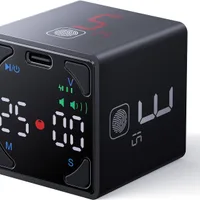
Ticktime Pomodoro Cube Timer
As an Amazon Associate, we earn from qualifying purchases — at no extra cost to you.
Step 2: Establish non-negotiable criteria first.
Before you open any tab or walk into any shop, write down two or three criteria any acceptable option must meet. Not the full wishlist — just the floor. Everything that doesn't clear the floor is eliminated without being compared. This converts a 40-option set into a 6-option set before you've done any real evaluating.
This kind of cutoff-based screening is a well-known decision strategy (related to what decision researchers call elimination heuristics) and a fast way to reduce cognitive load. You're not trying to identify the best option directly; you're first eliminating the clearly wrong ones, which is a much lower-cost task.
why-waiting-beats-forcing-a-decision-unconscious-thought-science
Step 3: Choose once, then stop revising.
The satisfaction dip from large option sets gets worse if you keep the question open after deciding. In a series of studies, Daniel Gilbert and Jane Ebert (2002, Journal of Personality and Social Psychology) found that people were more satisfied with choices they could not change than with ones they could — and that people didn't predict this in advance. The takeaway: treating a choice as made rather than provisional tends to help you feel better about it.
This doesn't mean ignoring new information that genuinely matters. It means distinguishing between "I discovered something important I didn't know before I chose" and "I'm wondering whether something better might exist." The second one isn't a question. It's a treadmill.
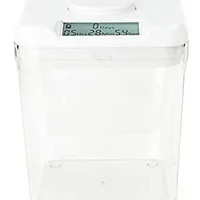
Kitchen Safe kSafe Time Locking Container
As an Amazon Associate, we earn from qualifying purchases — at no extra cost to you.
How to Start Today
Pick one decision you've been deferring — a purchase, a plan, a commitment. Not the biggest one on your list. The one that keeps resurfacing in your head without resolving.
Here's a version of this I've seen play out more than once: someone stuck between two job offers, both genuinely good. They spend weeks gathering more information — talking to people who've been there, running financial models, researching the companies. By week three, they're more confused than when they started. The ceiling wasn't set. The floor wasn't defined. The decision stayed open not because they lacked data, but because they'd never committed to a process for closing it.
Apply the three steps:
- Set your ceiling. How many options will you seriously consider? Write the number before you start looking.
- Write your floor. What are the two criteria any option must meet? Anything that doesn't qualify, eliminate it without comparing.
- Decide once. Compare your shortlist, choose, and treat the decision as made.
If you want a physical anchor for this process, a simple decision journal works better than a mental note. Writing your criteria before you start commits you to the frame you set, rather than letting the most appealing option redefine what you were looking for in the first place.
The harder version of this advice: apply it to your life, not just your purchases. How many directions are you genuinely pursuing right now? How many goals are active? The overload effect doesn't stop at the checkout. It scales to the size of the arena you bring it into.
The Menu You Design Before You Sit Down
The research on choice overload is messier than the jam study makes it sound. Near-zero mean effects, real moderators, and plenty of contradictions — that's the honest summary. Sometimes more options hurt, sometimes they don't, and expertise, stakes and familiarity all determine which.
Schwartz, Iyengar, Scheibehenne — they're all pointing at the same underlying truth from different angles. You have more control over how hard a decision feels than the options themselves would suggest. Not because the options change, but because the frame you bring to them does.
That's what "Design Your Evolution" means here. Not that you pick less. That you decide, deliberately, what gets on your menu before you sit down.
What's one decision you've been leaving artificially open — not because you need more information, but because you haven't set the ceiling yet?
Was this helpful?