Productivity· 11 min read
Afternoon Slump: Why It Isn't Just a Coffee Problem

Afternoon Slump: Why It Isn't Just a Coffee Problem
It's 2:47 PM. You've been reasonably productive all morning — cleared your inbox before lunch, tackled the hardest item on your to-do list before noon. And now you're staring at the same paragraph you've read three times without absorbing a word.
You reach for the coffee. Call it the afternoon slump, the 3 PM wall, or just one more cup you didn't want to need. The pattern is consistent enough that researchers have studied it in shift workers, surgeons, pilots, and office workers for decades. The explanation that comes out of that research is more interesting — and more actionable — than the usual advice about what you ate for lunch.
This is a story most people know. And for years, the default explanation was food: too many carbs, too heavy a meal, blood sugar yo-yoing after lunch. So you've probably tried eating lighter. Maybe you skipped lunch entirely for a few weeks. Maybe you switched to a salad. The slump showed up anyway.
That's because the afternoon crash isn't only a food problem. It's largely a biology problem — and once you understand the mechanism behind it, the whole conversation about what to do at 3 PM changes.
In the 1980s, sleep researcher Peretz Lavie, working at the Technion in Israel, used an ultra-short sleep-wake protocol (7 minutes of allowed sleep, 13 minutes awake) to map when the body is most and least able to fall asleep across the day. His 1986 work described "gates" and "forbidden zones" for sleep, and showed a peak in sleep propensity in the mid-afternoon, around 3 PM, coinciding with the well-known "post-lunch dip" in performance.
That dip is thought to be generated largely by the natural sleep-wake system itself, rather than by eating alone — though a heavy lunch can make it worse. Individual variation is notable, so this isn't a universal law, but for most people it's a real pattern.
You're not weak-willed. You're not low on motivation. Around early-to-mid afternoon, your core body temperature dips slightly and alertness and reaction times tend to fall.
The question isn't how to eliminate this window. You can't. The question is how to design around it.
What the 3 PM Crash Actually Is (And Isn't)
Think of your alertness as the product of two competing forces. One is sleep pressure — the accumulated drowsiness that builds with every hour you've been awake. The other is your circadian rhythm — the internal clock that pushes back against that drowsiness to keep you functional during daylight hours.
In the morning, that circadian push is strong. By mid-afternoon, it briefly relaxes its grip while sleep pressure is still climbing. For most people, this collision lands somewhere between 1 and 4 PM.
What can amplify the dip: poor sleep the night before, a large carbohydrate-heavy lunch, hours of sitting without moving, and dim artificial light throughout the day. Each of these is independently manageable. What doesn't help: working harder. Pushing through a circadian dip with willpower is like jogging into a headwind and blaming your shoes.
One amplifier that rarely gets the attention it deserves: sustained stillness. Sitting in one position for several hours slows circulation and removes the small postural adjustments your body uses to maintain alertness. A 5-minute walk — up and down a staircase, or around your floor — can interrupt that accumulating drowsiness in a way that a second coffee doesn't. It doesn't need to be exercise. It just needs to be movement.
Knowing the actual mechanism changes what you reach for at 2:47 PM.
Caffeine Timing: The Problem Isn't the Coffee, It's the Clock
Most people drink coffee later than is good for them — and when they do, they can pay for it that night.
In 2013, Christopher Drake and colleagues published a study in the Journal of Clinical Sleep Medicine in which 12 healthy normal sleepers took 400 mg of caffeine (several cups of coffee's worth) at bedtime, three hours before, or six hours before, compared with placebo. Each timing significantly disturbed sleep. Even with the six-hour gap — the equivalent of a late-afternoon dose for a midnight bedtime — objectively measured total sleep time fell by more than an hour. Participants didn't perceive the disruption, which is the sneaky part. It is a small study with a large dose, so treat it as a signal, not a precise rule.
The upstream consequence plausibly shows up the next afternoon: poorer sleep the night before tends to mean a harder dip the following day. If you're fighting the 3 PM slump with a late espresso, you may be borrowing against tomorrow's alertness to pay for today's.
A practical rule of thumb: stop caffeine by early afternoon, and keep the mid-morning cup you're probably already drinking. The riskiest one is the mid-to-late afternoon cup that feels like a necessity.
morning energy levels before 10am
Designing Around the Dip Instead of Through It
Here's the reframe that makes everything else easier: your afternoon dip isn't a productivity emergency. It's a scheduled recovery window. Your body isn't failing you between 1 and 4 PM. It's asking for a different kind of task.
Demanding cognitive work — writing, analysis, strategy, complex problem-solving — tends to feel harder during the dip. Administrative tasks, routine calls, low-stakes emails, reviews of work already done: these belong in your afternoon inventory. They're not lesser work. They're the right work for that window.
Worth noting: the exact timing of your dip is personal. Morning chronotypes — people who naturally feel alert early in the day — may experience their low point closer to 1 PM. Evening chronotypes may not feel it until 4 PM or later. Your wake time that morning and your recent sleep history both shift the window. This is one reason why the tracking experiment at the end of this article is more useful than any general rule: you're calibrating advice to your biology, not to a population average.
If you can design your schedule this way — deep work in the morning, routine tasks in the early afternoon, then taking advantage of the alertness rebound many people notice in the late afternoon — you stop fighting biology and start scheduling with it.
Two Things That May Blunt the Dip
A short rest. A NASA study of long-haul flight crews gave pilots a planned 40-minute rest opportunity during cruise phase. Pilots in the rest group slept on average about 26 minutes, and showed improved physiological alertness and performance compared with the no-rest group during the critical descent and landing phases. It was a small study in a specific operational setting, so treat it as a principle rather than a universal promise. The underlying concept — a brief planned rest that banks alertness for the demanding work ahead — has since been incorporated into some aviation and emergency medicine training. If you have a door to close or a quiet corner to use, it's a 15-minute experiment worth running.
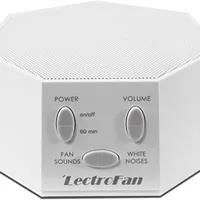
LectroFan Classic White Noise Machine (Global Power Edition)
As an Amazon Associate, we earn from qualifying purchases — at no extra cost to you.
Natural or bright light. Light is the most powerful signal the human circadian system receives. A 10-minute walk outside during your post-lunch dip is a sensible alternative to a second coffee — without the sleep-quality cost. If you work somewhere with no outdoor access, a bright light lamp used for 20-30 minutes in the early afternoon may help. The evidence here is moderate, not conclusive, and individual responses vary — but the mechanism is well-supported.

Philips SmartSleep Wake-Up Light HF3520 (Light Therapy)
As an Amazon Associate, we earn from qualifying purchases — at no extra cost to you.
What doesn't work as well as it feels: sugar. A quick hit from a biscuit or energy drink may lift you briefly, but many people notice a rebound that makes the second half of the afternoon worse. Same logic as the late coffee — you're borrowing, not generating.
How to Start: A Two-Week Experiment
You don't need to overhaul your day. Run a small test for 14 days.
Week one — observation only:
- Rate your energy from 12 PM to 5 PM on a simple 1-to-5 scale, every 30 minutes. You want to find where your personal low point actually falls — it may not land exactly at 3 PM.
- Note the time of your last coffee and your rough sleep quality that night (another 1-to-5 scale is enough).
Week two — one change at a time:
- Cut your last coffee of the day to no later than 2 PM. If persistent fatigue is a concern, speak to a clinician — this is a scheduling experiment, not a treatment.
- Move your most demanding tasks to the 9–11 AM window.
- During the dip window you found in week one, take a 10-to-15 minute real break: go outside, close your eyes, or shift to something genuinely low-demand.

Amazfit GTR 4 Smart Watch (46mm, Sleep & Heart Rate Tracking)
As an Amazon Associate, we earn from qualifying purchases — at no extra cost to you.
By day 14, you'll have actual data on your own pattern. Chronotypes are real — morning types, evening types, and everything in between have different dip windows. The experiment calibrates the advice to your biology, not to an average that may not fit you.
how to track your daily energy and build a schedule that works for you
The Rhythm Is Already There — You're Just Not Reading It
Your energy isn't a flat resource you draw from until it empties. It's rhythmic. Peaks follow troughs, and troughs follow peaks.
Your afternoon isn't broken. It has a different job than your morning does. Working with that rhythm — your most demanding work in the morning, routine tasks in the early afternoon, and a real break during the dip rather than another espresso — is more sustainable than fighting it. You don't need to win that fight. You need to stop showing up to it.
That's what "Design Your Evolution" means in practice: you use what the science tells you about your own biology to build a day that generates results instead of just absorbing effort.
What does your afternoon energy pattern actually look like right now? Not the one you assume — the one you'd find if you tracked it for a week. That answer might change everything you think you know about your productive hours.
Was this helpful?