Mindset· 12 min read
Decision Noise: Why Smart Groups Choose Badly

Decision Noise: Why Smart Groups Choose Badly
Picture two claims adjusters at the same insurance company. Same training. Same handbook. Same years on the job. You hand each of them an identical case — the same medical history, the same liability question, the same documented losses. One settles at $9,800. The other says $16,300.
Neither is careless. Neither is new. They just disagree by about 66 percent — and the company has no idea, because these two people never review the same case at the same time.
This isn't a story about incompetent people. It's a story about decision noise — a specific flaw in how judgment works that almost no one talks about. Not bias, the kind of systematic error you've probably read about. Something subtler, and in many ways harder to fix.
Daniel Kahneman — the psychologist who spent decades mapping how we get thinking wrong — spent years focused on bias. Then he and co-authors Olivier Sibony and Cass Sunstein turned their attention to something they'd largely been sidestepping: the sheer randomness of human judgment. The book they eventually wrote is simply called Noise. And the central finding is uncomfortable in a very specific way: wherever there is judgment, there is decision noise. Courts. Hospitals. Hiring committees. Investment firms. And in your own head, reading the same file on two different afternoons.
What Noise Actually Is
Most people conflate noise with bias, but they're structurally different problems.
Bias is a systematic error — you consistently lean in one direction. You overestimate how long things will take. You trust confident-sounding speakers more than quiet ones. These tilts are predictable, which makes them at least partially correctable.
Noise is random variability. Two equally qualified judges reach different conclusions from identical evidence. Or you yourself — reviewing the same case at 9am versus 4pm, before lunch versus after a difficult meeting — would reach a measurably different conclusion. There's no consistent direction. The error is the spread.
| Bias | Decision Noise | |
|---|---|---|
| Direction | Consistent — always tilts one way | Random — no predictable pattern |
| Visibility | Detectable over repeated cases | Invisible unless you compare side by side |
| Cause | Systematic thinking shortcuts | Variable judgment, context, and mood |
| Fix | Adjust for the known tilt | Build structure into the process |
In Noise, Kahneman, Sibony, and Sunstein describe what happens when companies run a "noise audit": trained professionals receive the same realistic cases and you measure how much their judgments diverge. The results surprised leadership. At one insurance company, the median difference between two underwriters pricing the same policy was about 55 percent (for claims adjusters setting payouts it was about 43 percent). Executives surveyed beforehand had expected a gap of around 10 percent. (CLM Magazine has a sharp breakdown of how these noise audits work in practice.)
The reason decision noise stays invisible is simple: each individual judgment looks reasonable on its own. You can't see the spread unless you compare side by side, and most organizations are structured in a way that makes exactly that kind of comparison rare.
cognitive biases in everyday decisions
Why Groups Make It Worse, Not Better
You'd expect that gathering smart people together would average out the noise. More perspectives, more balance. It's the logic behind committees, panel interviews, and strategy retreats.
It's mostly wrong.
In 2011, Lorenz, Rauhut, Schweitzer, and Helbing published a study in PNAS testing crowd wisdom directly. Participants answered estimation questions — the kind with objectively correct answers — and some were then shown others' answers. Social influence narrowed the diversity of estimates. Everyone converged toward a shared answer.
That sounds like progress. But accuracy didn't improve: the group's average was no better, even though people felt more certain. The statistical benefit that makes a crowd smarter than any individual erodes the moment people start updating based on what they hear from each other.
This is why committees often produce worse outcomes than a well-designed process would, even when the individuals in the room are excellent. It's not that smart people become dull in groups. It's that the architecture of the conversation — who speaks first, who projects confidence, who carries seniority — shapes the final answer before the actual reasoning begins.
The most senior person in a room doesn't need to say anything provocative to anchor everyone else. Simply speaking first does it.
The Decision Hygiene Checklist
Kahneman and his co-authors use the phrase "decision hygiene" — borrowed from public health, where you don't wait for disease to appear, you prevent it through structure. The same principle applies here.
These are the moves that actually reduce noise:
- Collect independent judgments before discussion. This is one of the most strongly recommended steps. Before any meeting where a judgment call will be made, ask each person to write down their assessment privately — their recommendation, their score, their estimate. Collect those first. Then discuss. This preserves the statistical benefit of independent perspectives. You still argue, deliberate, and update. You just do it after capturing what everyone genuinely thinks, rather than what they're willing to say in front of the most senior voice in the room.
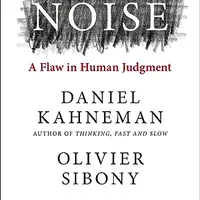
Noise: A Flaw in Human Judgment — Kahneman, Sibony & Sunstein
As an Amazon Associate, we earn from qualifying purchases — at no extra cost to you.
- Score before you rank. Ranking — comparing option A against option B against option C — amplifies noise because it's sensitive to order effects. The option you encounter first frames everything that follows. Absolute scoring (rate this candidate 1–5 on each criterion independently, before seeing the next candidate) produces more reliable judgments. It feels less natural, which is actually the point: it forces you to evaluate each case on its own terms.
Thinking, Fast and Slow — Daniel Kahneman
As an Amazon Associate, we earn from qualifying purchases — at no extra cost to you.
-
Strip irrelevant context where you can. Noise increases when judges see information that shouldn't affect the outcome — the claimant's tone, where a résumé fell in the stack, the day's news. Structured processes that isolate the decision-relevant facts reduce variability without requiring anyone to become a better thinker.
-
Run a personal noise audit. Pick two decisions you made in different contexts — different weeks, different moods, different energy levels — and check whether the same inputs would have produced the same output. Most people find they wouldn't. Not because they're inconsistent in character, but because judgment is context-sensitive in ways you don't notice until you test yourself.

Clever Fox Habit Calendar Circle (24-Month)
As an Amazon Associate, we earn from qualifying purchases — at no extra cost to you.
how to build a personal decision-making system
The Uncomfortable Part You Won't Hear in Most Meetings
Here's what most decision-making articles leave out: more discussion, before independent capture, tends to make noise worse.
When groups deliberate before locking in private estimates, the first voice carries disproportionate weight. This isn't a character flaw — it's how human cognition works. We update toward what we've heard, particularly from people who seem certain or senior. The more back-and-forth before the decision is made, the more the final answer reflects the social dynamics of the conversation rather than the combined evidence of the participants.
This cuts against almost every meeting culture most of us have absorbed. We're taught that deliberation is valuable — more voices, more iteration, more time. But in environments where individual judgment matters — hiring, risk assessment, editorial calls — unstructured discussion before independent capture is actively corrosive to decision quality.
How to Start This Week
You don't need an organizational overhaul. Here's the minimum viable version:
Before your next group judgment call, send a one-question message asking each person for their independent assessment. Two sentences max. Collect responses before the meeting starts. Use those to open the conversation rather than letting it develop organically from whoever speaks first.
For personal decisions, write your first instinct down before you research anything. The goal is to capture your actual starting point — not the one shaped by the first three sources that agree with each other.
Keep a simple decision log for one month. Record the decision, your confidence level, and your reasoning before you know the outcome. Review it at 30 days. Many people find that their confidence and their accuracy are only loosely correlated — which is exactly the kind of calibration data that improves future calls.
In any meeting with a clear seniority gap in the room, try one experiment: ask junior members to share their assessment before senior ones speak. Not for political reasons. For noise-reduction reasons. Senior opinions anchor the room the moment they land, and you lose information you could have had.

Kindle Paperwhite (12th Gen, 16GB)
As an Amazon Associate, we earn from qualifying purchases — at no extra cost to you.
Is decision noise the same in every field?
No, but it shows up in almost every domain that involves human judgment — medicine, law, hiring, finance, editorial decisions, insurance. The magnitude varies by field and by how structured the decision environment already is. Highly structured fields (e.g., radiology with standardized protocols) tend to have less noise than unstructured ones. But noise audits consistently reveal more variability than organizations expect, regardless of how professionalized the field is.
why your next big decision needs a pre-mortem
Designed Decisions
There's a line from Kahneman's work that sits with you after you've encountered it: wherever there is judgment, there is noise. It's not a pessimistic statement. It's an engineering one.
A reliable decision doesn't come from gathering the most confident people in a room. It doesn't come from longer meetings or more passionate argument. It comes from a process that respects how judgment actually works — variable, social, context-dependent, highly sensitive to order and to who speaks first.
Designing that process is within reach. A shared document before the meeting. A scoring sheet before the comparison. A personal log you actually review. None of it requires organizational transformation or expensive tools. What it requires is treating your decision process as something that can be designed — not just something that happens when smart people get in a room together.
That's the difference between making a decision and designing one. Design Your Evolution.
What's a call you're about to make where capturing independent views before discussion would change what you actually know going in?
Was this helpful?