Habits· 13 min read
Loving-Kindness Meditation: What the Studies Found

Loving-Kindness Meditation: What the Studies Found
There's a moment in Barbara Fredrickson's 2008 study that gets almost no coverage in the pop-psych summaries. Participants weren't told they were building a skill. They were taught to sit quietly and wish people well — loved ones, strangers, eventually themselves — using simple phrases like may you be happy, may you be healthy, may you be safe. Over the seven weeks of the program, those participants reported steady increases in daily positive emotions — joy, gratitude, love — that the waitlist group didn't show. And they hadn't done anything heroic.
That result is worth pausing on, because it cuts against what most people assume about meditation: that you need years of practice before it does anything measurable. The technique Fredrickson's team used is called loving-kindness meditation — metta in the Pali tradition — and it's one of the most studied forms of contemplative practice outside of focused-attention training.
What Loving-Kindness Meditation Actually Is
Strip away the spiritual framing and you've got something simple: a structured mental exercise where you deliberately generate warm feelings toward a sequence of targets — usually yourself, then someone you love, then a neutral person, then someone difficult, then all beings. You repeat phrases of goodwill, often silently, and try to feel the meaning behind the words rather than just recite them.
That last part matters. It's not an affirmation protocol. The practice asks you to cultivate a specific emotional texture — something closer to the warmth you feel watching a child play than the confidence you try to fake before a job interview.

Liforme Original Yoga Mat
As an Amazon Associate, we earn from qualifying purchases — at no extra cost to you.
The secular framing used in most Western research strips the cosmological claims entirely. No rebirth, no karma, no merit-making. Just a mental repetition exercise aimed at shifting your emotional baseline.
It's also worth being clear about what loving-kindness is not: it's not focused-attention meditation, where you anchor your mind to the breath and return when it wanders. That's attention training — a different skill. Loving-kindness is generative rather than receptive. You're not watching what arises; you're practicing the deliberate creation of a specific emotional state. If you've tried mindfulness meditation and found it neutral or uncomfortable, that experience may not predict how loving-kindness will feel — they draw on different mental machinery.
What Fredrickson's 2008 Study Found
The most-cited trial is Fredrickson, Cohn, Coffey, Pek, and Finkel (2008), published in the Journal of Personality and Social Psychology. In a field experiment, 139 working adults were randomly assigned to begin a loving-kindness meditation practice or to a waitlist control. The meditation group learned the practice in a seven-week program and practiced it over that period.
The result: meditators showed gradual increases in daily experiences of positive emotions — joy, gratitude, contentment, hope, love. Those increases, Fredrickson argued, translated into gains in personal resources — specifically, greater mindfulness, a stronger sense of purpose, reduced illness symptoms, and broader social support — which in turn predicted higher life satisfaction and fewer depressive symptoms at follow-up.
Fredrickson's explanation draws on her broaden-and-build theory: positive emotions don't just feel good in the moment — they temporarily widen your attention and that broadened state helps you accumulate lasting psychological resources. Loving-kindness, in this model, is a practice for entering that state on demand.
self-compassion and self-criticism
A few caveats worth knowing. The sample was self-selected — people who sign up for a meditation study at work skew toward already-curious, motivated adults. The control group got nothing, which means you can't separate the effect of loving-kindness from the effect of simply having a structured practice of any kind. And the outcomes were self-reported. There's no objective biomarker saying "positive emotion went up." These are real limitations.
The Clinical Evidence: Smaller and Messier
A 2011 review by Hofmann, Grossman, and Hinton in Clinical Psychology Review looked at loving-kindness and compassion meditation as potential tools for psychological interventions. Their conclusion was cautiously optimistic: the literature links these practices to more positive and less negative affect, and, combined with established treatments such as cognitive-behavioral therapy, they may offer useful strategies for problems involving interpersonal processes — depression, social anxiety, marital conflict, anger, caregiver stress. But the evidence they reviewed was preliminary, and the review itself was not based on a systematic literature search, as later meta-analyses have pointed out.
That matters because, in this field, studies are often small and active control conditions — where you compare meditation to another structured activity, rather than to doing nothing — are not the norm. If you give someone suffering from low mood regular structured, supportive group time, they tend to improve regardless of what happens during those minutes.

Kindle Paperwhite (12th Gen, 16GB)
As an Amazon Associate, we earn from qualifying purchases — at no extra cost to you.
The honest summary: loving-kindness meditation shows up as useful in enough independent studies that dismissing it entirely would be wrong. But the effect sizes are modest, the best trials are small, and the mechanism isn't fully understood. If you're dealing with significant depression or anxiety, it's not a replacement for professional support — it may be a complement to it.
Here's a quick overview of the trials the evidence most often draws on:
| Study | Design | Main finding |
|---|---|---|
| Fredrickson et al. (2008) | 139 adults, 7 weeks, waitlist control | Gradual increase in positive emotions; gains in purpose, mindfulness, social support |
| Hutcherson, Seppala & Gross (2008) | Single session, matched control | Increased social connection and positivity toward strangers |
| Hofmann, Grossman & Hinton (2011) | Narrative review | Cautiously positive link to reduced negative affect; evidence preliminary |
| Kang, Gray & Dovidio (2014) | 101 adults, 6 weeks, active control | Decreased implicit bias; effect absent in discussion group |
The Self-Compassion Overlap
One reason researchers keep studying loving-kindness is what it appears to do to your internal monologue. Kristin Neff's self-compassion research, and the work that followed it, suggests that many people's default inner voice is markedly unkind — particularly after a failure or a mistake. Loving-kindness practice explicitly targets self-directed warmth during the "self" phase of the meditation.
hedonic adaptation and positive emotion
If your inner critic is doing significant damage — and for a lot of people it is — a practice that deliberately rehearses self-directed kindness is a reasonable thing to test, even though the evidence for that narrower effect is still modest. Something worth noting: the "self" phase is often the most uncomfortable one. Many practitioners report that directing warmth outward — toward a loved one, toward strangers — is relatively easy. Directing it inward is where they stall. If that's true for you, that friction is probably useful information about where the practice's work actually lies.
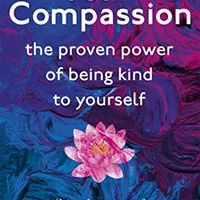
Self-Compassion: The Proven Power of Being Kind to Yourself — Kristin Neff
As an Amazon Associate, we earn from qualifying purchases — at no extra cost to you.
Does It Change How You Act Toward Others?
Hutcherson, Seppala, and Gross (2008), in Emotion, found that even a brief loving-kindness exercise increased feelings of social connection and positivity toward strangers, compared with a closely matched control task. Kang, Gray, and Dovidio (2014), in the Journal of Experimental Psychology: General, randomly assigned 101 adults to a six-week loving-kindness practice, a loving-kindness discussion group, or a waitlist, and found that implicit bias against Black people and homeless people decreased only in the practice group. These are small studies, one of them a single-session design, and the effect on actual behavior in real-world settings remains hard to measure.
A 5-Minute Practice to Try
Here's a stripped-down version of the standard loving-kindness protocol:
Sit comfortably. Close your eyes or lower your gaze. Take three slow breaths to settle.
-
Self (90 seconds). Silently repeat: May I be safe. May I be healthy. May I be happy. May I live with ease. Don't rush the phrases. Try to feel the warmth behind them rather than recite mechanically. If it feels awkward, that's normal — it's supposed to be a little unusual.
-
Someone easy (90 seconds). Bring to mind someone you care for without complication — a child, a close friend, a pet. Direct the same phrases toward them: May you be safe. May you be healthy. May you be happy. May you live with ease.
-
Wider (60 seconds). Expand outward: a neighbor you barely know, then a wider circle — your city, people you'll never meet. Same phrases, same warmth.

Ticktime Pomodoro Cube Timer
As an Amazon Associate, we earn from qualifying purchases — at no extra cost to you.
That's five minutes. Research programs generally used longer sessions than this, so treat five minutes as a starting point rather than a replicated dose. The idea behind it is repeated activation of a particular emotional register — practicing warmth the way you'd practice any other skill: by using it, repeatedly, over weeks. That's a working hypothesis, not a demonstrated mechanism.
What to Realistically Expect
Most people who try loving-kindness meditation for the first time find it slightly strange and not particularly emotional. That's fine. The effects in the studies accumulated over weeks, not sessions.
If you're going to run an honest experiment on yourself, a sensible minimum trial is probably four weeks of daily practice. Use a timer so you're not watching the clock. Five minutes every day will almost certainly outperform twenty minutes twice a week — not because the total time is better, but because consistent contact with a practice is how the habit gets encoded.

Clever Fox Habit Calendar Circle (2-Year)
As an Amazon Associate, we earn from qualifying purchases — at no extra cost to you.
What you're measuring, loosely, is whether your default inner climate shifts — whether you catch yourself being slightly less harsh after a mistake, or slightly more interested in the stranger you pass on the street. These aren't dramatic outcomes. They're not meant to be. The idea isn't transformation through epiphany; it's the quieter possibility that you can deliberately train the emotional texture of your inner life the same way you can train attention or sleep.
This is what designing your evolution actually looks like at the level of daily practice: not a dramatic overhaul, but a low-cost daily choice that compounds quietly over months. The research isn't settled. But the signal is real enough to be worth five minutes of your morning.
What would change — in a day, in a week — if the voice inside your head was reliably a bit kinder? That's not rhetorical. It's the actual experiment.
morning routine habits and rituals
Was this helpful?