Productivity· 10 min read
The Micro-Break: Short Pauses That Protect Your Focus
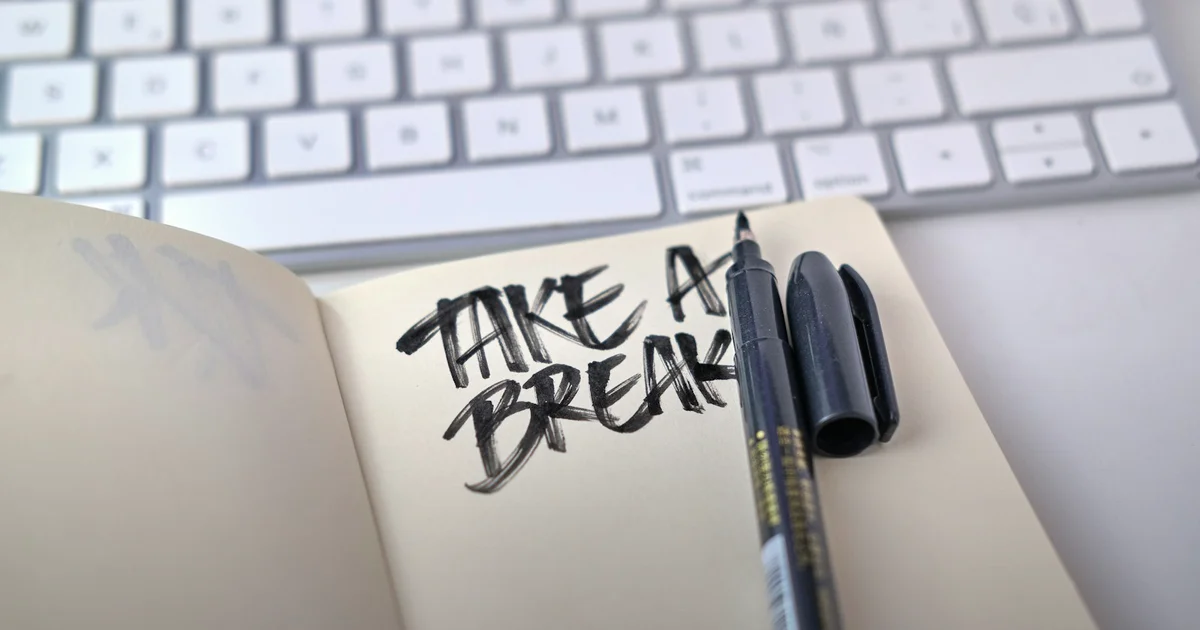
The Micro-Break: Short Pauses That Protect Your Focus
You tell yourself you'll push through to the end of the chapter, the email, the report. Just fifteen more minutes. Then fifteen becomes thirty, thirty becomes an hour, and by the time you finally stop, you're not tired — you're gone. The words on screen are just shapes. The next sentence takes three attempts to start. What you protected by not stopping was exactly what you lost.
Most of us were taught that breaks are a reward for finishing — something you earn after the hard part. But that framing gets the relationship completely backwards.
There's a growing body of research on what happens to focus and energy during sustained work. A 2022 meta-analysis published in PLOS ONE by Albulescu and colleagues pooled 22 independent study samples (from 19 research records, 2,335 participants in total) on micro-breaks: short pauses of ten minutes or less taken during work, distinct from a lunch hour or an end-of-day shutdown. Their finding: micro-breaks produced small but statistically significant gains in "vigor" — the feeling of being energized and alert — and reduced fatigue. The effect on performance overall was not significant, though it appeared for less cognitively demanding tasks, and longer breaks were linked to larger performance gains.
Not coffee. Not a longer lunch. Short, deliberate pauses inside the workday.
The effect size isn't enormous — roughly 0.35 for both vigor and fatigue — and the studies were mostly short-term, controlled settings. But the pattern is consistent enough to take seriously. You don't need to overhaul your entire schedule. You need to deliberately design two or three pause points inside it, then actually use them.
What a Micro-Break Actually Is (and Isn't)
A micro-break is a short, intentional pause from your primary task, usually between two and ten minutes. No meditation practice required, no standing desk to install, no productivity app to configure. The only condition is that you choose to stop — and that you set a clear endpoint so the pause actually ends.
The intention is what separates a micro-break from a distraction. Checking your phone compulsively between tasks, drifting to email when you're stuck, half-watching a video while your report waits — none of that is a real pause. It is the diffuse, vaguely guilty drift most of us know too well.
The distinction matters because intentional breaks and accidental drifts produce different outcomes. When you choose to stop — stand up, step away from the screen, set a two-minute timer — you give yourself a clear recovery interval. When you're half-working and half-scrolling, you're in an unhelpful limbo: not resting, not focused. Research on attentional recovery consistently shows this kind of blurred half-stop fails to deliver the cognitive reset that a genuine pause provides.
Modern knowledge work makes this harder because there's no natural stopping point. A surgeon knows when the operation is done. A carpenter can see when the shelf is cut. But when your work lives entirely in your head and on a screen, the task boundary is always negotiable — which means the pause is always negotiable too. That negotiability is exactly what you have to override by design.
The Research on Break Activities — What You Do Matters
Here's where the findings get practical.
Kim, Park, and Niu published a diary study in the Journal of Organizational Behavior in 2017 (86 South Korean office workers tracked over ten workdays) examining which micro-break activities help people recover from daily work demands. They looked at four types: relaxation, nutrition-intake, social, and cognitive activities. One clear result was that cognitive activities during a break made the link between work demands and negative mood worse rather than better.
Kitchen Safe kSafe Time Locking Container (Medium)
As an Amazon Associate, we earn from qualifying purchases — at no extra cost to you.
That suggests the break where you dive into more mentally demanding content is a poor choice. A break where you get a glass of water, stretch for two minutes, and look out the window before coming back asks nothing of your attention — and takes exactly the same amount of time.
The likely reasoning is intuitive: sustained cognitive work draws heavily on directed attention, the effortful, top-down focus you apply to a problem. What restores it isn't more stimulation — it's low-demand recovery, where little is competing for your attention. Your brain isn't refusing to work; it's waiting for a quiet interval where it can consolidate and reset.
Being constantly in motion is not the same as doing good work. Brief, clean pauses are part of the production function, not a tax on it.
When to Take the Break (This Part Is Counterintuitive)
Most people take a break when they're exhausted. That's the equivalent of waiting until you're completely dehydrated before drinking water — the deficit has already accumulated, and a small input won't immediately reverse it. By then the work you pushed through has already suffered, and a short pause may not be enough to repair it.
The more useful principle: schedule the pause before you need it.
As a starting default, many people try one short pause for every 60 to 90 minutes of focused work. That is a practical rule of thumb, not a research-backed prescription. Individual variation is real, task type matters, and the research samples are mostly office workers and students in short-term settings. But it gives you something to test and adjust from, which is more useful than waiting for the perfect number.
Some people use Pomodoro (Italian for "tomato," named for the tomato-shaped kitchen timer used by the technique's inventor) timers set to 25-minute work blocks with 5-minute breaks. The specific numbers don't have special scientific status — what the system delivers is a mandatory pause before fatigue arrives. You're not waiting to feel tired. The structure makes the stop happen automatically.
Three Break Designs Worth Trying
Personal fit matters. Here are three worth running as a short experiment this week:
The two-minute visual reset. Stop everything, step away from the screen, and find a window or an outdoor view. Let your gaze settle on something at distance — this gives your visual system a different demand than the close-range, high-contrast work of reading a screen. If you can step outside briefly, even better.
The physical reset. Stand up and move for three to five minutes. Slow shoulder rolls, a walk to another room, some light stretching at your desk. This is not a workout — it's a circuit breaker for long stretches of sitting.
Liforme Original Yoga Mat
As an Amazon Associate, we earn from qualifying purchases — at no extra cost to you.
The social reset. A brief, non-work conversation — in person or a quick voice call. The key is brief. You're not solving a problem or making a decision; you're shifting your brain into a different register for two or three minutes, then returning.
What tends not to work as a micro-break: checking email, reading the news, working through demanding material. These feel like resting because they're not your primary task, but they keep you processing information and reacting. Rest that demands your attention isn't rest — it just looks like it from the outside.
How to Start Today
You don't need a new system. You need three small decisions, made once in advance.
1. Set your break times before the workday starts, not in response to fatigue. A rough scaffold might be pauses at mid-morning, noon, mid-afternoon, and late afternoon. Adjust for your work structure, but start with something fixed rather than negotiable — a slot you can move, but can't simply skip.
2. Use a physical trigger. A timer, a phone alarm, a visual cue on your desk. Relying on an internal feeling to prompt the pause usually means it arrives too late, or not at all. External triggers remove the negotiation entirely.
3. Decide what you'll do on the break before you're in it. When you're already depleted, you default to the path of least resistance — usually your phone. Pre-commit instead: my 10:30 break is two minutes at the window and a glass of water. Specific enough to follow, simple enough to actually do.
Amazfit GTR 4 Smart Watch (46mm, Black)
As an Amazon Associate, we earn from qualifying purchases — at no extra cost to you.
Recovery Is a Design Variable, Not a Reward
The idea that rest is something you earn by finishing is one of the most persistent distortions in how people think about productive work. Recovery isn't a reward — it's a structural element of your day. The harder decisions, the careful sentences, the problems that require actual thought — those come from a system that hasn't been run past its limits.
The rhythms of your workday — when you push, when you pause, when you let the system recover before the next sustained effort — are the structure. A badly designed schedule produces a badly functioning mind, and willpower applied on top of that rarely changes the underlying equation.
how to design a productive work environment
Design Your Evolution isn't about hacking yourself into doing more. It's about building a daily structure where sustainable, high-quality work is the default — because the environment was built to support it rather than quietly erode it.
So: what does a break actually look like in your workday right now? And when's the last time you took one before you needed it?
Was this helpful?