Habits· 12 min read
Save More Tomorrow: The Trick That Beats Willpower

Save More Tomorrow: The Trick That Beats Willpower
You've made the promise before. More times than feels comfortable to count.
Next paycheck, you'll set aside something real. Open that savings account you've been meaning to open for six months. You mean it. The intention is genuine every single time.
Then the money lands. Rent. Groceries. The subscription you forgot about. The small things that each feel reasonable in isolation. By the time you remember the savings plan, the month is somehow already over — and the number hasn't moved.
This pattern isn't about desire or knowledge. It's not a character flaw. It's a design problem: the architecture of the standard savings system is almost perfectly built to fail the average human brain. The Save More Tomorrow approach offers a different design — one that stops asking you to win an unwinnable argument with yourself every month.
Why Willpower Is the Wrong Tool for This Job
Saving money makes a very specific demand on you. It asks you to voluntarily accept a real, immediate loss in exchange for a benefit that is abstract, distant, and easy to discount.
Behavioral economists call the underlying mechanism present bias — the near-universal tendency to weight immediate outcomes far more heavily than equivalent future ones. The £100 in your account today feels categorically more real than the £200 it might become in twenty years. Your future self is, to your current brain, something close to a stranger. And most people don't sacrifice for strangers.
Almost every standard savings system is built on willpower: receive money, choose to save some, resist the urge to spend it. The same hard decision, every month, under the same conditions that make the wrong choice easy. That's an endurance test with no finish line.
present bias and financial decisions
The research on this produced one of the most replicated findings in behavioral economics. In 2001, economists Brigitte Madrian and Dennis Shea published a study in the Quarterly Journal of Economics examining what happened when a large U.S. company changed one thing about its 401(k) retirement plan. Not the employer match. Not any financial incentive. Just the default.
Previously, employees had to actively opt in to enroll. The company switched to automatic enrollment — everyone was enrolled by default, with the option to opt out.
Among employees with three to fifteen months of tenure, participation rose from roughly 37% to 86%.
Same company. Same plan. Different starting position — and with it, a markedly different outcome for new hires. The study also found that many people simply stayed at the default contribution rate, which is a reminder that defaults shape behavior in both directions.
The default effect is a well-documented behavioral phenomenon: when a choice is presented as the baseline, most people accept it without active deliberation. That inertia, usually framed as a barrier to good financial behavior, becomes a significant asset when the default is pointed in the right direction.
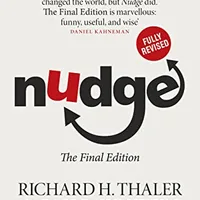
Nudge: The Final Edition — Richard H. Thaler & Cass R. Sunstein
As an Amazon Associate, we earn from qualifying purchases — at no extra cost to you.
The SMarT Program: Committing Before the Conflict Arrives
Save More Tomorrow (SMarT) is a behavioral savings program built on a deceptively simple insight: commitment in advance, made before the moment of sacrifice, costs your present self almost nothing — and protects your future self from being overruled at the worst possible time.
A few years after the Madrian and Shea findings, economists Richard Thaler and Shlomo Benartzi formalised this idea. Their paper in the Journal of Political Economy (2004) introduced Save More Tomorrow — SMarT — designed specifically for people who genuinely wanted to save more but couldn't bring themselves to do it today.
The logic was deliberately simple. Instead of asking employees to increase their contributions now — which requires an immediate, visible sacrifice — the program asked them to commit in advance to saving a portion of their next raise.
The raise doesn't exist yet. Agreeing to redirect part of a hypothetical future paycheck doesn't feel like a loss; it feels like a sensible decision about something that hasn't happened. And by the time the raise arrives, the contribution moves automatically — before anyone adjusts their lifestyle to the new income.
Thaler and Benartzi ran this at a mid-sized U.S. manufacturing company. Employees who joined the SMarT program saw their average savings rate rise from 3.5% to 13.6% over 40 months, through four pay-raise cycles. Not from encouragement, not from financial education — from a structural commitment made well before the moment of decision.
The mechanism is what psychologists call pre-commitment: you lock in a choice before the conflict between your present and future self arises. The present self agrees once, from a calm and rational position. Then the decision is essentially made — the future self doesn't have to win the same argument every paycheck.
Worth being clear about the limits: those figures are averages for the employees who chose to join, in a specific employer setting with a particular population, and effect sizes in similar programs vary. Defaults help people start, but they don't lock in behavior permanently. And nothing here constitutes personalized financial advice — debt, variable income, or complex financial situations deserve a conversation with a qualified adviser.
The System That Runs Without You
Most personal finance advice is actually behavioral advice in financial clothing. Spend less. Track everything. Make better choices. This guidance is technically accurate and largely useless for the same reason telling someone to "just eat less" doesn't address hunger — it treats the symptom and ignores the design.
The standard saving sequence — earn, spend, save whatever remains — tends to fail. Spending often expands to fill available income, a pattern commonly called lifestyle creep. The money that was supposed to be saved becomes the last item in a spending cascade that perpetually runs over. There is no surplus, because the sequence was never designed to produce one.
The behavioral alternative reverses the order: earn → save first → spend what remains.
behavioral design and habit systems
This is the long-standing "pay yourself first" principle. The phrase sounds like motivational shorthand, but the behavioral economics gives it real structural weight. When you move money on the day your salary arrives — automatically, before anything registers as available in your mental accounting — you're exploiting the same inertia that Madrian and Shea documented. The money in the separate account stays there not because you're disciplined, but because accessing it requires a deliberate decision most people never get around to making.
The behavioral mechanism is mental accounting — the tendency to treat money differently depending on which mental category it occupies. Money that has already left your main account stops registering as available to spend; it doesn't compete with weekend plans or an online checkout, because it's simply not part of the pool you're drawing from.

The Psychology of Money — Morgan Housel
As an Amazon Associate, we earn from qualifying purchases — at no extra cost to you.
How to Set This Up Before the Week Is Out
You don't need an employer program or a financial planner to use these principles. You need about thirty minutes and one decision that you only have to make once.
Step one. Open a savings account at a different bank or institution from your main current account. The friction matters — a second login, a transfer that takes a day, an interface you have to deliberately navigate. This makes accessing your savings feel like a conscious choice rather than a frictionless tap. Some people find that naming the account helps — 'Emergency Fund', 'House Deposit', '2029 Freedom'. The label matters more than it rationally should: behavioral research on mental accounting consistently shows that a named account feels categorically different to spend from than an unnamed one.
Step two. Set up an automatic transfer for the same day your salary arrives — not after rent, not after you've seen what's left. Before the money registers as available. Even a modest amount moved automatically is more reliable than a larger amount you intend to move once you've sorted everything else. Consistency beats size at the start.
Step three. Right now — not after the article ends — write down your next expected raise or bonus. Then commit, in writing, to directing at least half of any increase directly into savings before you update your spending to reflect the new income. This is the SMarT mechanism on a personal scale. It costs you nothing today. It captures tomorrow's optimism before present bias has a chance to override it.
Step four. Review the account quarterly rather than weekly. Once the automation is running, the most useful thing you can do is step back and leave it alone for ninety days. A system that works without you watching it is a system that's actually working.
The Decision You Make for Someone Who Can't Make It Yet
You're making a decision on behalf of your future self — the person who will actually live inside the financial environment you are designing right now, and who has no vote in today's moment.
The design principle the research keeps pointing to is precise: decide once, from your most rational position, when you're not under immediate pressure or temptation. Automate the outcome.
This isn't a personality upgrade, and it's not about becoming more disciplined. The person who sets up an automatic transfer on a quiet Tuesday afternoon and the person who keeps meaning to are probably not meaningfully different — except one has made the decision from a position of calm clarity, before the argument between present and future self had a chance to begin.

Kindle Paperwhite 2024 (12th Gen, 16GB, Black)
As an Amazon Associate, we earn from qualifying purchases — at no extra cost to you.
You don't save more by wanting it more. You save more by building a system that runs whether or not you want it in the moment — one that protects your future self from your present self's reasonable-sounding objections.

Clever Fox Habit Calendar Circle (24-Month)
As an Amazon Associate, we earn from qualifying purchases — at no extra cost to you.
That's what designing your evolution looks like in practice. Not a dramatic transformation, not an extraordinary act of discipline — one system, set once, quietly compounding toward the version of your life you'd choose if you were always thinking clearly.
What's the one automatic transfer you could set up before this week is out?
Was this helpful?