Habits· 12 min read
Ten Minutes a Day: Does Short Practice Really Build Skill?
Ten Minutes a Day: Does Short Practice Really Build Skill?
You've probably done this. You blocked off a Saturday afternoon, pulled out the guitar — or the sketchpad, or the Spanish workbook — and hammered away for two straight hours. It felt productive. By Sunday evening the motivation had drained out. The guitar went back in the corner. Three weeks passed.
Then you tried again.
That cycle — a surge of effort followed by nothing — is how most people practice. And it's almost exactly backwards from what the research on deliberate practice says actually builds skill.
The 10,000-Hour Rule Got It Wrong
Malcolm Gladwell's version of the 10,000-hour rule became one of the most repeated ideas in self-improvement: put in ten thousand hours, become world-class. It made mastery sound like a simple matter of accumulating time.
The problem is that Gladwell was summarising — and significantly simplifying — the work of psychologist K. Anders Ericsson, whose 1993 paper with Krampe and Tesch-Römer in Psychological Review was about the structure of practice, not the total volume. Ericsson's core argument was that what separates experts from intermediates isn't just how many hours they've logged. It's what they do with that time.
Then in 2014, a meta-analysis by Macnamara, Hambrick, and Oswald in Psychological Science added a sceptical note. After reviewing decades of research across multiple domains, the authors found that accumulated deliberate practice explained a meaningful but surprisingly modest portion of the variation in performance — about 12% overall — and that the size of this effect differed considerably by domain. It accounted for roughly 26% of the variance in games and 21% in music, but only about 4% in education and less than 1% in professions.
The honest conclusion: practice is necessary. It is not sufficient. And volume without quality explains much less than the popular version of the story suggests.
What does explain it?
What Deliberate Practice Actually Is
Deliberate practice is purposeful repetition aimed at a specific skill gap, performed at the edge of your current ability, with feedback that tells you whether you got it right. Unlike casual practice, it requires discomfort by design — and that discomfort is exactly where the learning lives.
Here's the distinction Ericsson made that the 10,000-hour shorthand erased: not all practice is deliberate practice.
In his framework, deliberate practice has specific features. It's purposeful — aimed at a defined skill gap, not just comfortable repetition of things you already know. It's uncomfortable — you're working at or just beyond your current ability. And it requires feedback — from a teacher, a recording, or some external reference that tells you whether you got it right.
Playing the same three guitar chords you've already mastered for two hours? That's rehearsal. It feels productive, and it has real value for performance confidence. But it cements what you already have rather than extending it.
Spending ten focused minutes on the one chord transition you keep fumbling — stopping each time you get it wrong to understand specifically what's going wrong — that's closer to the real thing.
The difference is clearer when you see it directly:
| Regular Practice | Deliberate Practice | |
|---|---|---|
| Goal | Feel productive, stay fluent | Target a specific skill gap |
| Difficulty | Comfortable repetition | At or just beyond current ability |
| Duration | As long as motivation lasts | Short, focused sessions |
| Feedback | Implicit, if any | Explicit and immediate |
| Result | Reinforces what you already know | Extends your current ability |

Peak: Secrets from the New Science of Expertise — Anders Ericsson & Robert Pool
As an Amazon Associate, we earn from qualifying purchases — at no extra cost to you.
This is why time alone doesn't predict skill development. The quality of attention and the specificity of the target are what determine how much a session actually transfers into lasting ability. Understanding this doesn't require perfect conditions or a formal coach. It just requires a clear target and the willingness to stay uncomfortable for ten minutes.
Why Short Sessions Work Better Than You Think
There's a reason coaches have long favoured short, concentrated repetitions over marathon sessions. The research on deliberate practice gives that instinct some support.
First, the capacity for genuine deliberate practice is limited. Ericsson's review of the research suggested that even elite performers can sustain deliberate practice for only about four hours a day, with diminishing returns beyond roughly two. The focused attention it requires is genuinely depleting. A short, intense session often produces more learning per minute than a long one where concentration has long since thinned out.
Second, skill development is partly a consolidation process. When you practise, you're not simply filing away information — you're triggering a process of strengthening neural connections that continues after the session ends, during rest and sleep. Daily practice, even in small doses, gives that consolidation process something to work with every single day.
Third, and most practically: a ten-minute session has almost no friction. You don't need to block your calendar or wait for the right mood. You need ten minutes and the specific thing you're working on. That low bar is not a limitation — it's the feature.
The worst practice session you actually show up for beats the ideal session you keep postponing.

Sony WH-1000XM5 Noise Cancelling Headphones
As an Amazon Associate, we earn from qualifying purchases — at no extra cost to you.
The Structure of a 10-Minute Session
Ten minutes sounds small. Structuring it deliberately is what separates a productive session from just touching the thing you're trying to learn.
A simple framework:
Two minutes — identify today's target. Don't open the notebook and just start. Decide, specifically, what skill gap you're addressing today. "Get better at French" is too vague. "Practise the subjunctive mood with irregular verbs in context" is a target.
Six minutes — focused execution with feedback. Work on exactly that target. When you get it wrong, stop. Identify why. Adjust. Repeat. This is where the discomfort lives, and it's also where the learning is. If you're not hitting friction, you're probably not working at the right edge.
Two minutes — log what happened. One sentence: what you tried and what you noticed. This matters more than it sounds. It closes the session in a way your brain registers as intentional work, and it gives you a data point for tomorrow. Over weeks, the log becomes a visible record of real progress — which is easy to miss when you're living inside the process.

Clever Fox Habit Calendar Circle (24-Month)
As an Amazon Associate, we earn from qualifying purchases — at no extra cost to you.
why-consistency-is-so-hard-science-of-staying-on-track
The Part Nobody Tells You About Progress
Here's the uncomfortable part: skill development is non-linear and mostly invisible at first.
The first few weeks of a new practice often feel like nothing is happening. You're showing up, logging the sessions, and you still can't play the passage cleanly or write the sentence naturally. This is normal — and it's also when most people quit, because the gap between effort and visible result is at its widest.
What's actually happening, below the surface, is that your nervous system is building the internal model that makes fluency possible. The payoff isn't distributed evenly — it tends to arrive in jumps, often after what feels like a stubborn plateau.
The ten minutes you show up for in week two won't feel significant. The compound effect of two hundred sessions will.
identity-based-habits-do-they-really-work
How to Start Today
The standard advice is to start small. Better advice is to start specific.
-
Pick one skill with one measurable gap. Not "get fit" — "do one clean pull-up." Not "learn Spanish" — "use the subjunctive correctly in a full sentence without looking it up." The narrower the target, the more useful the session.
-
Set a timer for ten minutes. A physical timer removes the need to check the clock, which fragments attention.
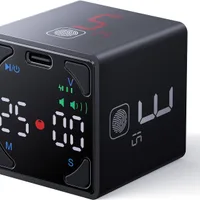
Ticktime Pomodoro Cube Timer (Black, USB-C)
As an Amazon Associate, we earn from qualifying purchases — at no extra cost to you.
Start the session when you press go, and don't stop until the timer ends.
-
Define what feedback looks like. How will you know if you got it right? A recording, a comparison against a reference, a correct/incorrect signal from an app. Without a feedback loop, you're mostly guessing at your progress.
-
Practise at the same time for the first two weeks. Not because habit science demands a fixed hour, but because those first two weeks carry the highest friction. A regular slot eliminates the daily negotiation about when to start.
-
Write one sentence after every session. Paper works. A sticky note works. The act of recording matters more than the medium or the level of detail.
That's the protocol. It won't make you world-class in a year — and the research says nothing that extreme was ever guaranteed by any protocol. But it will make you measurably, visibly better at something you care about. Without requiring a lifestyle overhaul. Without requiring ten thousand hours upfront.
Practice Is a Design Question
The 10,000-hour rule intimidated a generation of people out of starting. If expertise demands that level of commitment, why bother if you can't go all in?
But Ericsson's real contribution was never a number — it was a description of a structure. And the more sceptical 2014 findings don't undermine that structure; they make it more honest. Practice matters, volume without quality is largely noise, and the gap between what you do in a session and how you do it matters more than the total hours you log.
It scales, too. Build one skill in ten focused minutes a day, and you're really building the meta-habit of showing up for deliberate attention. That transfers to every skill you pick up next.
Ten focused minutes, repeated daily, targeted at a specific gap, with real feedback. That is not a shortcut. That is the actual mechanism. Each session is a small act of design — a decision to evolve toward something specific, one intentional repetition at a time.
What's one skill you've been meaning to work on — and what would ten minutes on the hardest part of it look like today?
Was this helpful?